Richard Accused a Mechanic of Scratching His Car — Then the Garage Cameras Showed the Damage Was Already There Before She Touched It
Chapter 13 — The Camera Didn’t Make Sarah Innocent
Richard finished photographing the car.
Sarah walked toward him.
“Planning a court case?”
Richard laughed.
“I’ve become very interested in before pictures.”
He pointed toward a small chip near the rear bumper.
“Already there.”
Sarah smiled.
“Noted.”
This time the service was routine.
An oil change.
Tire rotation.
Basic inspection.
When Richard returned, he walked around the vehicle.
Then stopped.
There was a fresh-looking dark mark near one wheel.
His first reaction came automatically.
That wasn’t there this morning.
He felt the old anger begin.
Then he stopped.
He looked toward Sarah.
“Can we check something?”
Sarah walked over.
“Sure.”
Richard pointed.
“I don’t remember this mark.”
“Could we check the intake photos before I assume anything?”
Sarah smiled slightly.
“Absolutely.”
They opened the morning images.
The mark was there.
Same location.
Same shape.
Richard stared.
Then laughed at himself.
“I genuinely would have sworn that was new.”
Sarah nodded.
“That’s why we check.”
Richard picked up his keys.
“Thank you.”
No argument.
No accusation.
No camera footage required beyond a simple photograph.
That small interaction was more meaningful to Sarah than Richard’s apology months earlier.
He had said he would behave differently.
Now he had.
The original incident eventually faded from the garage’s daily conversation.
But Mark continued using it during staff training.
Not with Richard’s name.
Not to mock the customer.
As an example of why condition documentation mattered.
Photograph vehicles before service.
Record obvious exterior damage.
Keep camera coverage of work areas.
Do not argue when evidence can answer the question.
And if the garage actually causes damage, acknowledge it just as clearly.
Sarah liked that last part.
She never wanted the lesson to become:
Customers are always wrong.
They were not.
Sometimes a technician did make a mistake.
Sometimes equipment scratched paint.
Sometimes a tool slipped.
Accountability worked both ways.
The point was to establish what actually happened before deciding who was responsible.
Richard learned the same lesson outside the garage.
Several months later, Elaine came home angry because a small dent had appeared on another family vehicle.
“Someone hit me in the parking lot.”
Richard asked:
“Did you see it happen?”
Elaine stopped.
Then laughed.
“No.”
Richard smiled.
“Then let’s check what we know before declaring war on anybody.”
They found an older photograph.
The dent had been there for weeks.
Elaine stared at him.
“You are enjoying this far too much.”
Richard laughed.
“I’ve paid for this lesson emotionally.”
The story of the silver sedan remained embarrassing to him.
But he did not rewrite it.
He had noticed a long scratch shortly after leaving a repair garage.
He assumed the timing proved the garage caused it.
Then he chose a specific mechanic to blame.
Sarah.
He walked into her workplace.
Pointed at her.
And said:
“You scratched my car.”
Sarah told him the damage was already there.
Richard refused to believe her.
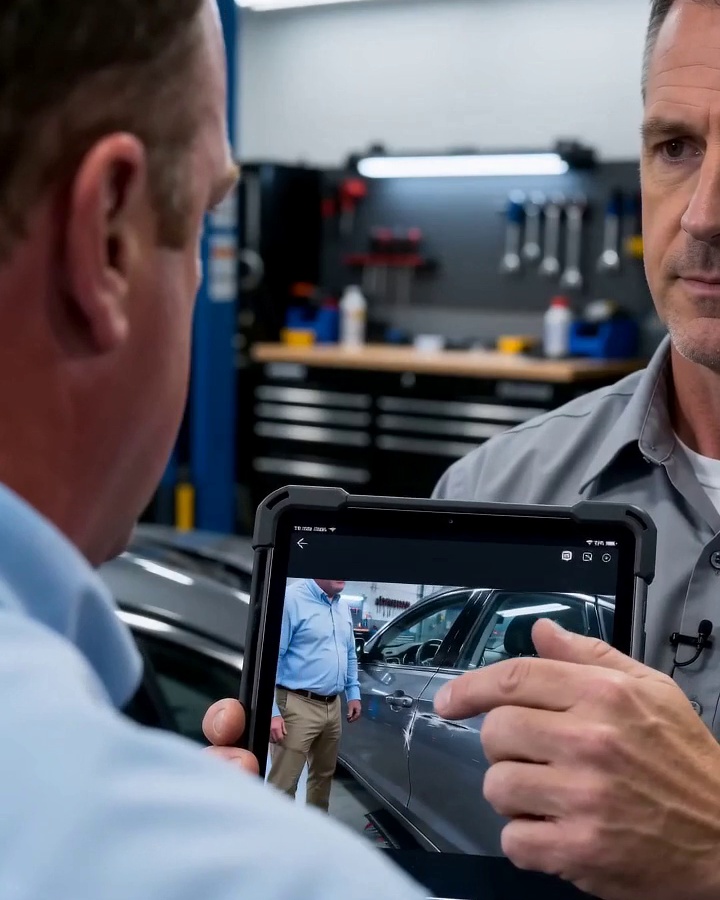
Then Mark arrived with the tablet.
“The cameras recorded the whole bay.”
The first video showed the car at check-in.
The scratch was visible.
Before Sarah began working.
A second camera made it clearer.
The intake sheet documented it.
Sarah’s timestamped photograph recorded it.
An independent delivery-truck camera showed it before the car even entered the garage.
Then Elaine’s message showed the damage the previous evening.
And finally the grocery-store footage revealed exactly how it happened.
A loose shopping cart.
A sloped parking lot.
A metal corner striking the driver’s door.
The sequence was complete.
Sarah had never caused the scratch.
The security cameras did not make her innocent.
She had been innocent before Mark opened the footage.
The cameras simply made it impossible for Richard’s accusation to remain stronger than the facts.
And they exposed something else too.
By Richard’s own later admission, he began suspecting he was wrong almost as soon as the first video played.
But instead of correcting himself, embarrassment made him fight harder.
That was the part he regretted most.
Being mistaken for thirty seconds was one thing.
Continuing to accuse someone after evidence challenged him was another.
Sarah eventually accepted his apology.
Not because Richard deserved instant forgiveness.
Because his behavior afterward showed he understood what he had done.
He corrected the false claim publicly.
He stopped using “misunderstanding” to disguise who had made the accusation.
And the next time he noticed possible damage after a repair, he asked for evidence before assigning blame.
Years later, Richard could barely remember how much the body shop charged to repair the original scratch.
But he remembered Sarah’s face when he shouted:
“You said I did that.”
He remembered Mark continuing the recording.
And he remembered the garage going quiet when another camera showed the scratch already running across the door.
The evidence did not humiliate Richard.
His certainty had done that.
The evidence simply gave him a choice.
Keep defending the accusation.
Or admit what the camera had already made obvious.
Sarah never scratched his car.
She never lied about the damage.
And once the full footage played, everyone in that garage knew exactly which person had been telling the truth from the beginning.
THE END
“`